June 18, 2026
9 Minutes to read
Shopify Spring 2026 Editions: The 5 Updates That Actually Change How You Sell

Recent blogs



share this article


Table Of Content
Section
Key takeaways: The Shopify Spring 2026 Editions release includes more than 150 updates, but the one that matters most is the shift to agentic commerce, where shoppers discover and buy your products inside AI assistants rather than only on your storefront. The five updates worth acting on now are AI-channel selling via Shopify Catalog, Shop Pay on any platform, Campaign Autopilot, self-serve order changes, and B2B features on more plans. The single highest-leverage move for most D2C brands is auditing product data so AI channels can surface it.
A founder opens the Shopify Spring 2026 Editions page, sees “150+ updates,” and scrolls. Agentic this. Sidekick that. Catalog APIs, multi-entity payouts, USDC cashback. Ten minutes later they close the tab with the same feeling they had before: a vague sense that something important just happened, and no idea what to do about it on Monday.
That reaction is normal. Shopify ships these editions twice a year, and the list is built to be comprehensive, not prioritized. But buried inside those 150+ updates is one shift big enough to change how you think about your store for the next two years, plus a handful of features worth acting on now. This guide to the Shopify Spring 2026 Editions sorts the signal from the noise for direct-to-consumer brands, and explains what each change means in practical terms.
The headline isn’t a feature. It’s a direction.
For most of Shopify’s history, your online store was the destination. You drove traffic to it, optimized it, and measured everything by what happened on those pages. The Spring 2026 Editions release quietly retires that assumption.
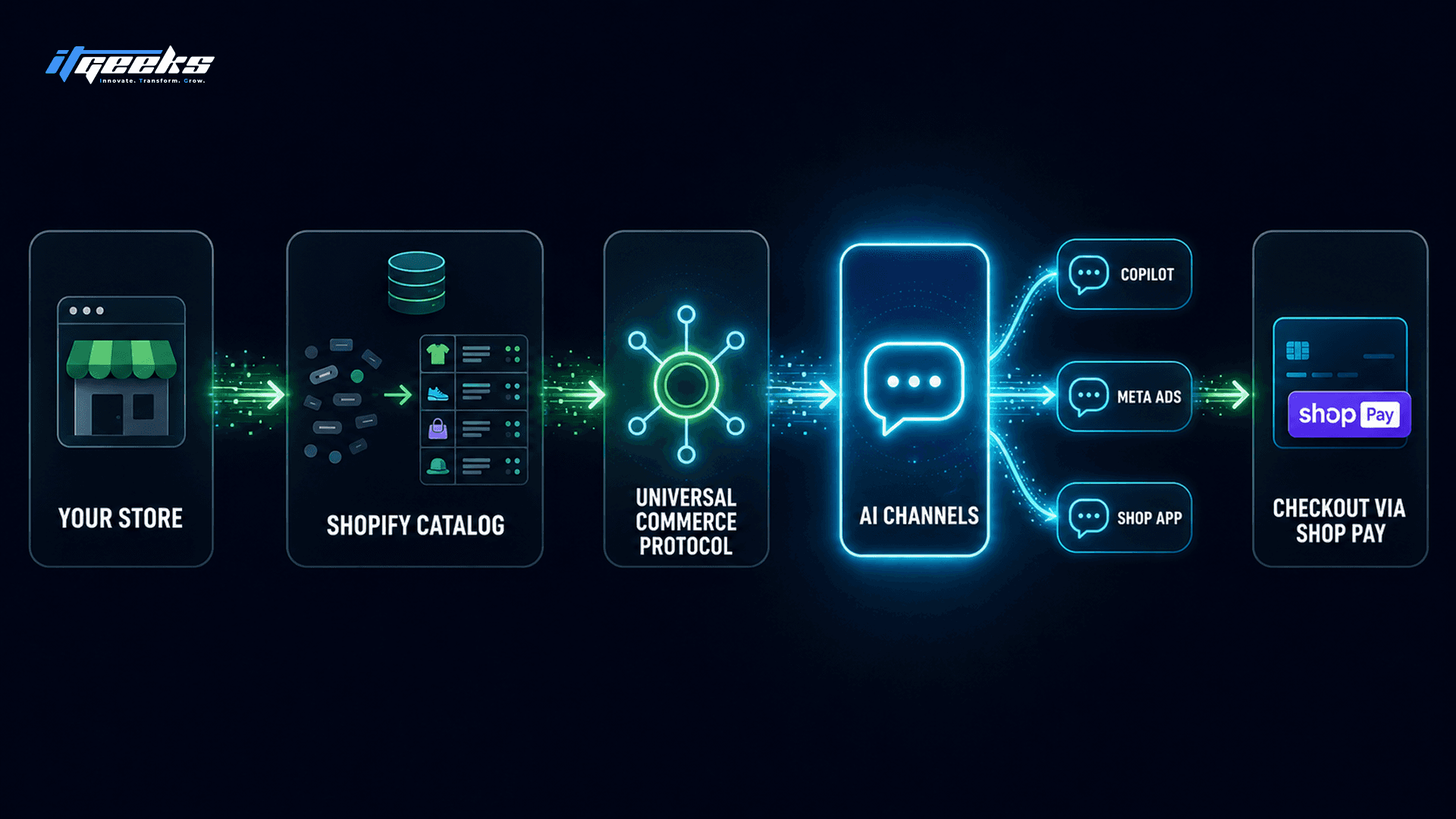
The center of this edition is what Shopify calls agentic commerce. In plain terms: your products now flow into AI channels automatically, and customers can discover and buy them without ever landing on your homepage. Shopify Catalog standardizes and enriches your product data, then syndicates it to AI surfaces like Microsoft Copilot, with Meta ads coming next, all powered by a shared standard Shopify calls the Universal Commerce Protocol. Shoppers can complete the purchase inside the chat and pay with Shop Pay.
According to Shopify, product data it syndicates drives roughly 2x more conversion in AI chats. Whether or not that figure holds for your category, the direction is unmistakable. A shopper can now ask an assistant for “a durable weekender bag under $150,” get your product recommended, and check out, all in a conversation you were never part of.
Here is the part most recap posts miss. In that world, the quality of your product data matters as much as the quality of your storefront design. An AI cannot recommend a product it does not understand. Clean titles, structured attributes, accurate variants, and complete specifications stop being a tidy-up task and become a growth lever. The brands that treat their catalog as infrastructure will get surfaced. The ones with thin, messy product data will be invisible in the exact place where discovery is moving.
That is the strategic takeaway. Everything below is how it shows up in features you can use.
Which Shopify Spring 2026 updates are worth your attention?
Out of the full list, these are the ones that change a real decision for a typical D2C brand.
1. Your products are now sold inside AI channels
This is the agentic shift made concrete. Through Shopify Catalog and the Universal Commerce Protocol, your products can appear and be purchased inside AI assistants. There is also an Agentic plan for businesses not on Shopify, letting them sync products to the Catalog and sell across AI channels and the Shop app.
What it means for you: audit your product data now. Make sure titles describe the product clearly, that variants and attributes are complete, and that descriptions read like answers to the questions a shopper would actually ask. This is the new SEO, and it is early enough that doing it well is a genuine edge.
2. Shop Pay is now available on any platform
Shop Pay, which Shopify reports gives access to a network of 250M+ shoppers with one-click checkout, is no longer limited to stores running on Shopify. Brands on other platforms can now offer it at checkout, with simplified onboarding.
What it means for you: if you have ever lost a sale to checkout friction, accelerated checkout is one of the highest-leverage conversion levers available. For Shopify merchants this strengthens an advantage you already have. For multi-platform operations, it removes a reason to fragment your stack.
3. Campaign Autopilot and Shop Campaigns expand across channels
Shopify introduced Campaign Autopilot, AI-powered marketing that runs campaigns across channels, learns, and optimizes while you set guardrails. Separately, Shop Campaigns now run on more surfaces, including ChatGPT, Pinterest, and programmatic ads through Microsoft Monetize.
What it means for you: paid acquisition is consolidating into the platform where your sales data already lives. That tightens attribution and reduces the number of dashboards you manage. It does not replace strategy, but it lowers the operational cost of running cross-channel campaigns.
4. Self-serve order changes from the order status page
Customers can now request to cancel an order before fulfillment, or return it after, directly from the order status page, without opening a support ticket.
What it means for you: the post-purchase window has been a quiet drain on support teams for years. Native self-service here means fewer “can I change my order” emails and fewer mistakes that turn into returns. It is a small line in the edition with an outsized effect on operational load for high-volume stores.
5. B2B features opened up across more plans
Company profiles, volume pricing, and up to three B2B catalogs are now available across more plans at no extra cost, rather than being reserved for the top tier.
What it means for you: if you have wholesale or bulk buyers and have been running them through spreadsheets and manual invoices, the native tooling to handle them properly is now within reach. For brands weighing a B2B expansion, the barrier just dropped.
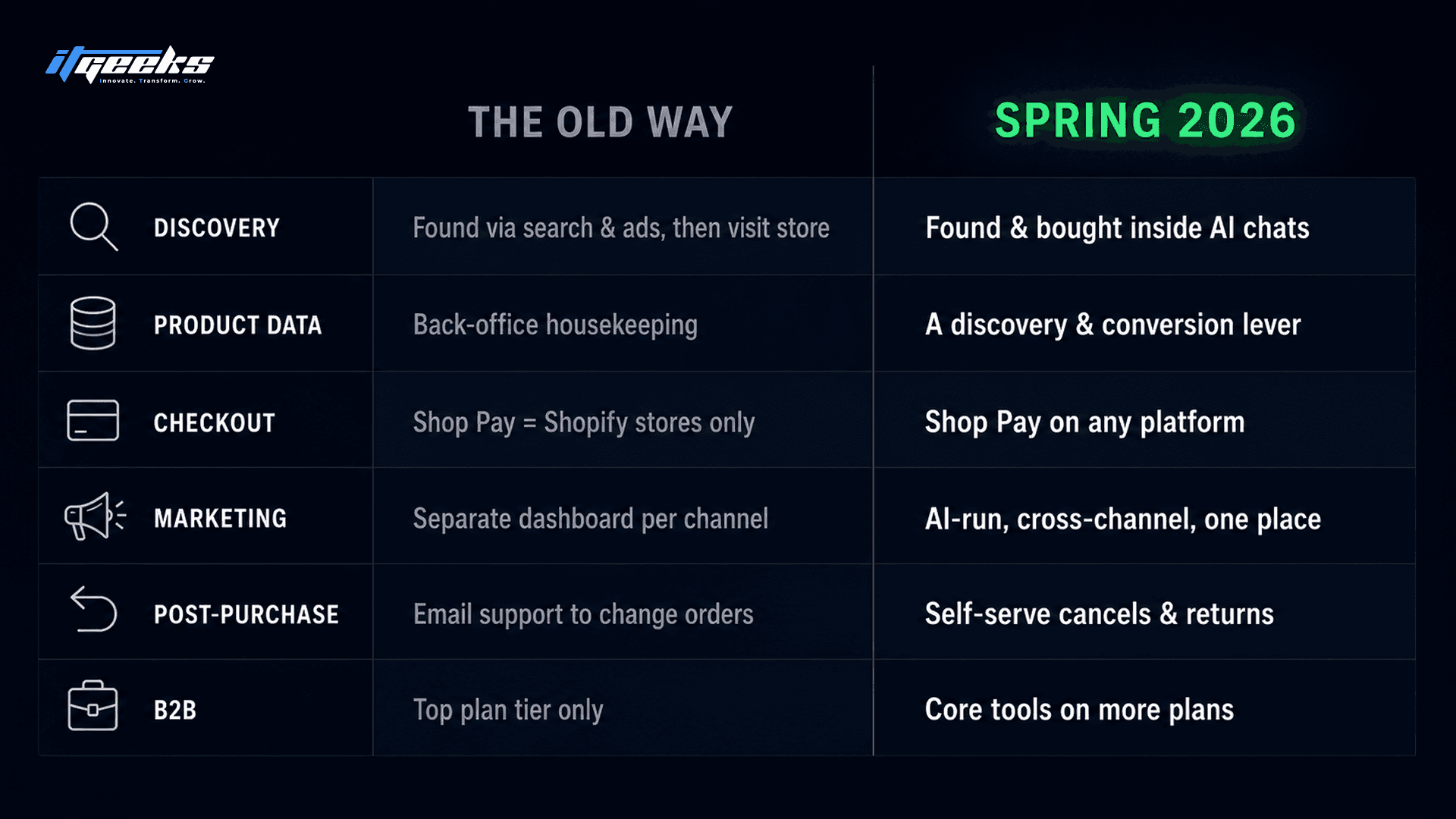
Then and now: how the shift looks in practice
What should you actually do this quarter?
You do not need to act on 150 updates. You need to act on the shift and a few features. A reasonable sequence for most D2C brands:
First, treat your product catalog as infrastructure. Clean up titles, fill in structured attributes, and make sure variants and specifications are complete and accurate. This is the single most important move because it determines whether AI channels can surface you at all.
Second, review your checkout and accelerated payment setup. If you are leaving conversion on the table at the final step, that is the fastest win available.
Third, if you have any wholesale demand, evaluate whether native B2B tooling now covers what you have been doing manually, or whether a B2B expansion is now worth scoping.
None of this requires a full rebuild. It requires knowing which moves compound and which are noise. That sorting is the hard part, and it is exactly where a Shopify Plus partner earns its keep.
The pattern behind every edition
Having built and migrated thousands of Shopify stores, we have watched this cycle repeat. The platform makes a move. A small group of brands leans in early, treats the change as infrastructure rather than a feature to bolt on later, and compounds the advantage. A year later they are competing on experience and discovery while everyone else is still catching up on the basics.
The Spring 2026 Editions release is one of those moments. The agentic shift will not feel urgent in the first month, which is precisely why early movers will pull ahead. The brands that get their product data and selling surfaces ready now will be the ones AI channels recommend when the rest of the market is still figuring out what changed.
If you are looking at the Editions list trying to decide what is signal and what is noise for your specific store, that is the conversation worth having. It is the one we have with merchants every day.
Frequently asked questions
What is Shopify Editions?
Shopify Editions is a twice-yearly release where Shopify announces its newest platform updates in one place. The Spring 2026 edition included more than 150 updates spanning AI and agentic commerce, payments, marketing, retail, B2B, and developer tools.
What is agentic commerce in Shopify?
Agentic commerce refers to shoppers discovering and buying products through AI assistants rather than only through a traditional storefront. In the Spring 2026 Editions release, Shopify enables this through Shopify Catalog, which structures and syndicates product data to AI channels, and the Universal Commerce Protocol, which lets customers purchase inside the conversation.
Do I need to do anything to sell in AI channels?
Shopify gets products into AI channels automatically, but results depend on the quality of your product data. Clean, complete, well-structured titles, attributes, and descriptions help AI assistants understand and recommend your products, which is why a catalog audit is the recommended first step.
Is Shop Pay only for Shopify stores now?
No. As of Spring 2026, Shop Pay is available to brands on any platform, not just stores hosted on Shopify, with simplified onboarding.
Which Spring 2026 update matters most for a small D2C brand?
For most small direct-to-consumer brands, the highest-leverage move is improving product data quality to prepare for AI-driven discovery, followed by optimizing accelerated checkout for conversion. Both deliver returns without a full store rebuild.

IT Geeks Team
Senior Brand Manager