

A general Shopify agency can build you a beautiful store. Migrating an existing store onto Shopify is a different skill entirely: it means moving years of order history, customer data, and SEO equity off a platform like Magento, BigCommerce, WooCommerce, or Salesforce Commerce Cloud without breaking any of it. Get it wrong and you lose search rankings overnight, corrupt customer records, or go dark during a launch window you can't move.
That's why this list only includes agencies with verifiable, migration-specific proof of work: a dedicated migration case study naming the source platform, a real client result, and a Shopify Partner status that's been checked directly.
Several commonly recommended names got cut during research for exactly this reason, more on that below the list.
Quick Comparison
Agency | HQ | Source Platforms | Rating |
ITGeeks | Salt Lake City, UT | Magento/Adobe Commerce, BigCommerce, WooCommerce, Salesforce Commerce Cloud, Wix, Squarespace, Shopware, PrestaShop, OpenCart | 5.0 (395+ reviews), Clutch Top Shopify Company 2024 and 2025 |
Codal | Chicago, IL | Magento | 4.9/5 (21 reviews) |
First Pier | Portland, ME | WooCommerce, Magento, BigCommerce, Squarespace, Weebly, Wix, custom | 4.9/5 (23 reviews) |
Elogic Commerce | Tallinn, Estonia (Brooklyn, NY office) | Magento 1 & 2, BigCommerce | 5.0/5 (66 reviews) |
Blue Stout | Portland, OR | Magento, custom platforms | Unrated on Clutch (unclaimed profile) |
Fuel Made | Seattle, WA | Volusion, Shopify-to-Shopify 2.0 | 5.0/5 (28 reviews) |
1. ITGeeks
ITGeeks is a Shopify Platinum Partner and was named a Clutch Top Shopify Company in 2024 and 2025, based on verified client reviews, with a 5.0 rating across 395+ verified Clutch reviews.

Migration is one of the agency's core practices rather than a side offering: it maintains 13 separate, platform-specific migration pages, covering moves from Magento and Adobe Commerce, BigCommerce, WooCommerce, Salesforce Commerce Cloud, Shopware, PrestaShop, Wix, Squarespace, Shopline, OpenCart, custom platforms, and Shopify-to-Shopify-Plus upgrades.
Its most detailed public migration case study is Janisource, a move from BigCommerce to Shopify Plus that specifically preserved full B2B feature parity, custom pricing tiers and company accounts included, rather than treating the migration as a simple product-catalog transfer. That B2B-specific detail matters: it's the part of a migration most agencies skip and most merchants regret skipping.
2. Codal
Codal, based in Chicago, is a Shopify Platinum Partner (confirmed directly on Shopify's own partner directory) with a Clutch rating of 4.9 out of 5 from 21 reviews. Its strongest public migration proof is the Thermos and Lifefactory case study: both brands were running on "a legacy version of the Magento eCommerce platform," and Codal migrated the full ecommerce infrastructure to Shopify Plus in eight weeks, within a three-month total project window. Codal reports a 38% increase in conversion rate and a 468% increase in revenue following the move (self-reported, no independent audit available, worth asking for a current reference before signing).

One honest caveat: Codal's dedicated migration landing pages are thin on specifics about which source platforms they cover. The Thermos case study, not the service pages, is the real evidence here, so ask directly about experience with your specific source platform rather than assuming from the page copy.
3. First Pier
First Pier, based in Portland, Maine, has the widest verified range of source platforms on this list. Its migration services page states plainly: "We've migrated from WooCommerce, Magento, BigCommerce, Squarespace, Weebly, Wix, and various custom-built platforms," with a scope that includes "catalog and metafield transfer, customer and order history, a complete 301 redirect map." That redirect-map detail is exactly the kind of specificity worth looking for, a huge share of migration SEO losses come from skipped or sloppy redirects, not from the product data itself.
Their clearest case study is Helen Milan, a WooCommerce-to-Shopify move that First Pier reports drove a 55% increase in orders post-migration. First Pier holds Shopify's "Select" partner tier and a Clutch rating of 4.9 out of 5 from 23 reviews, both confirmed directly.
4. Elogic Commerce
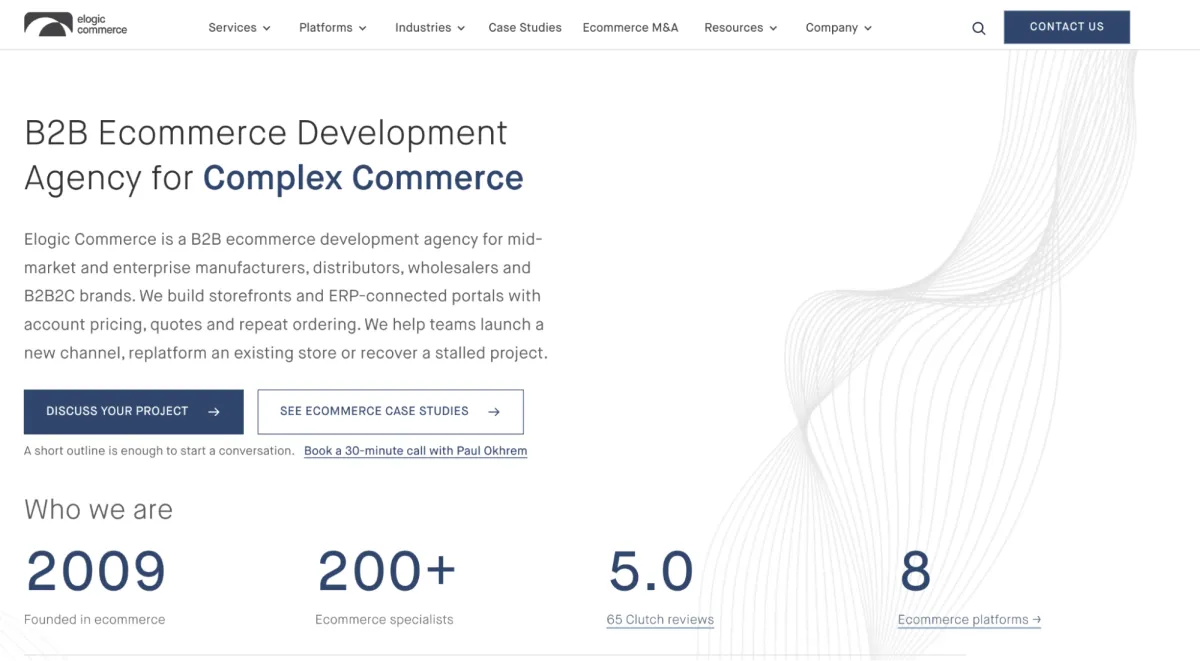
Elogic Commerce is headquartered in Tallinn, Estonia, with a client-facing office in Brooklyn, New York, worth knowing upfront since engineering delivery is based in Estonia even though the agency serves US clients and shows up reliably in US-agency searches. What Elogic brings that's genuinely strong: a Clutch rating of 5.0 out of 5 from 66 reviews, the highest review volume on this list, and a detailed case study moving EET Group from Magento 1 to Shopify Plus for a B2B operation, reporting a 40% drop in annual platform maintenance costs and a 25% increase in conversion rate alongside a 15% lift in average order value.
If working with a team whose engineering is based outside the US is a dealbreaker for your organization (some procurement policies require it), this one's worth a direct conversation about where the actual migration work happens before moving forward.
5. Blue Stout
Blue Stout, based in Portland, Oregon, has two named migration case studies with real specifics: moving Zildjian and Vic Firth, two brands under one company, from Magento to Shopify Plus in under three months, and moving Speck off a custom-built platform onto Shopify Plus in under ten weeks ahead of a hard business deadline.
The honest flag here: Blue Stout's Clutch profile exists but is unclaimed and shows no reviews yet ("Not yet reviewed"), so there's no third-party rating to point to. That doesn't mean the work isn't good, the case studies are specific and verifiable, but it does mean you're relying on their own account rather than an independently verified score. Ask for a direct client reference if this is the deciding factor.
6. Fuel Made
Fuel Made, based in the Seattle, Washington area, carries a Clutch rating of 5.0 out of 5 from 28 reviews and lists platform migration explicitly among its specialties on Shopify's own Plus partner directory. One useful, verified cross-platform case: a Volusion-to-Shopify migration for LifeSource Vitamins covering more than 1,700 product pages, drawn from a client review rather than a dedicated case study page.
Worth being precise about: Fuel Made's two most-cited headline results, for Pela and Tuft & Paw, are Shopify-to-Shopify-2.0 replatforms, not migrations from a different CMS. They're good evidence of execution quality and page-speed gains, but if you're specifically moving off Magento, BigCommerce, or another platform, ask for a cross-platform reference rather than leaning on those two numbers alone.
Who Got Cut, and Why
A few names that show up repeatedly in "best Shopify agency" roundups didn't make this list, on purpose. Corra had a strong Magento-to-Shopify-Plus case study, until a direct check showed Corra was acquired by Publicis Sapient in 2023 and its old case-study pages now redirect to Publicis Sapient's generic commerce page with no mention of Corra, Shopify, or the original project. Groove Commerce markets Shopify migration work, but every quantified case study we could verify was for BigCommerce projects, not Shopify. A few other frequently-recommended names had no verifiable migration-specific case study or service page at all, just a generic mention of "migration" buried in a services list. We'd rather leave an agency off this list than pad it with one that doesn't hold up to a direct check.
What a Real Migration Actually Involves
Part of why this list is short is that a genuine Shopify migration is a lot more than moving a product CSV from one admin panel to another. A few pieces consistently separate agencies that do this well from ones that treat it as an afterthought:
Data mapping, not just data transfer
Products, variants, and customer records rarely have a clean one-to-one field match between platforms. Magento's complex product attributes, BigCommerce's option sets, and WooCommerce's custom fields all need to be deliberately mapped to Shopify's metafield and variant structure, not dumped in as-is. Get this wrong and you end up manually fixing thousands of product listings after launch.
A complete 301 redirect map
Every indexed URL on the old platform (not just product pages, also category pages, blog posts, and any landing pages with backlinks) needs a mapped redirect to its Shopify equivalent. This is the single most common point of SEO damage in a migration, and it's also the easiest to verify an agency actually plans for: ask to see a sample redirect map from a past project before signing.
Order history and customer accounts
Shopify doesn't import password hashes from most platforms, so customers typically need to reset their password after migration, something worth communicating to your customer base in advance rather than letting them discover it at checkout. Historical order data needs to transfer in a way that keeps your accounting and customer service history intact, not just show up as a flat export.
App and integration parity
Whatever your current platform does through custom code or a specific plugin (a loyalty program, a subscription model, an ERP sync) needs an actual Shopify-side equivalent identified before migration day, not figured out after launch when the gap becomes a support fire.
A defined cutover window with a rollback plan
Good migration agencies plan for what happens if something goes wrong on launch day, not just the happy path. If an agency can't describe what their rollback looks like, that's a real gap, not a minor detail.
How to Evaluate a Migration Agency Yourself
Every agency above passed a basic bar: a named case study, a specific source platform, and a rating we checked directly. That's a starting point, not a substitute for your own vetting. You can go through our detailed guide on choosing the right Shopify migration agency, covering the questions worth asking before signing (what's the redirect plan, what happens to support after launch, how is data reconciliation handled) and the common red flags, like a quote with no itemized breakdown or a team that can't name a specific client reference on your source platform.
Want to migrate from one platform to the other, irrespective of which is which? You can book a call with the experts here.
Frequently Asked Questions
How much does a Shopify migration typically cost?
It varies widely by catalog size, how much custom functionality needs to be rebuilt, and whether you're moving to standard Shopify or Shopify Plus. None of the agencies on this list publish flat migration pricing, which is reasonable given how much scope varies. Treat any agency quoting an exact number before seeing your current site and data as a red flag rather than a sign of transparency.
How long does a typical migration take?
Among the verified case studies above, timelines ranged from under 10 weeks (Speck, a custom platform to Shopify Plus) to around 3 months (Zildjian/Vic Firth, Thermos/Lifefactory, both Magento to Shopify Plus). Complexity, not company size, is the bigger driver: a simpler catalog with fewer integrations moves faster regardless of which agency handles it.
Will I lose my Google rankings during the move?
Not if it's handled correctly, but it is the single biggest risk in any migration. The core protection is a complete 301 redirect map covering every indexed URL, combined with preserving your existing meta titles, structured data, and content rather than rewriting everything at launch. See the SEO-during-migration guide linked above for the specifics.
Should I migrate to standard Shopify or Shopify Plus?
That depends on what's actually driving the move. If you're leaving a platform because of checkout limitations, B2B requirements, or multi-store complexity, Plus is usually the better landing spot. If you're simply leaving an expensive or unreliable legacy platform and don't have those specific needs, standard Shopify may be the more cost-effective fit. ITGeeks' guide on whether Plus is the right fit walks through that decision in more depth.
Making the Decision
The agencies on this list all cleared the same bar: real evidence of migration work, not just a Shopify badge. Past that, the right fit depends on your specific source platform, your budget, and how much you weigh a verified review count against a strong case study with no third-party rating attached yet.
If you want a direct read on your specific migration, what it would actually involve, what it would cost, and which of these approaches fits your situation, get in touch with ITGeeks for a plan built around your current platform and your actual data, not a generic quote.